Software · Siel Orchestra
Siel Orchestra, a 1979 string machine, every key sounding.
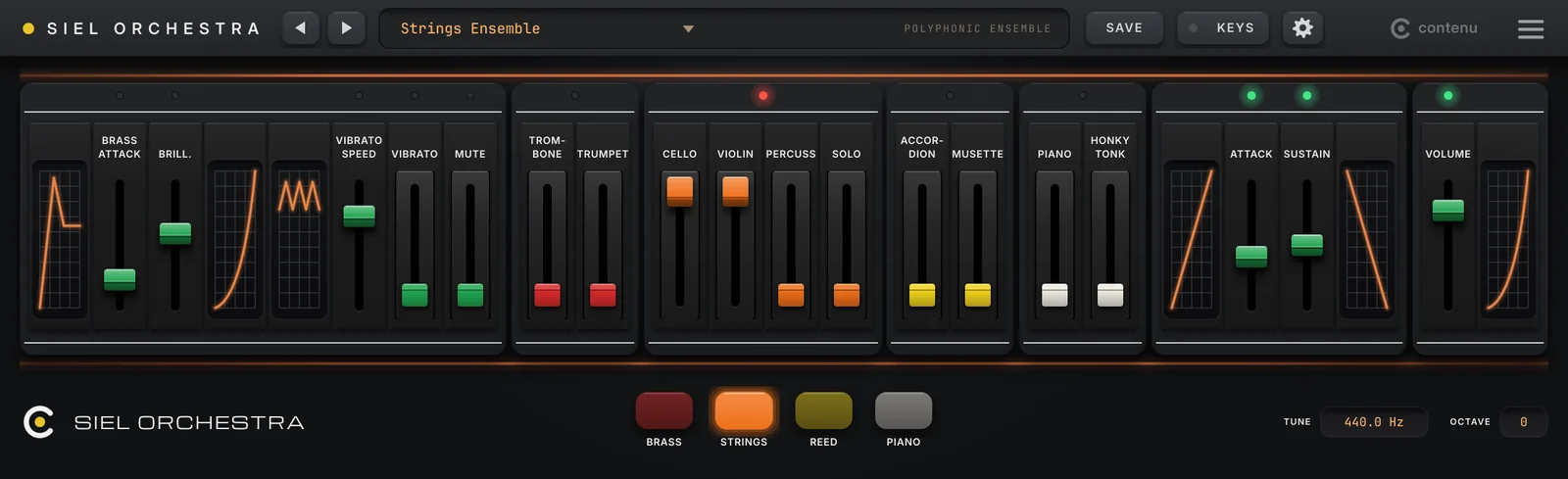
Siel Orchestra is a fully polyphonic string machine with brass, reed and piano beside the strings. It was built from the service schematics of an Italian ensemble keyboard from 1979, sold in America as the ARP Quartet.
Four families from one generator.
One divide-down tone generator feeds four families of sound. Switch a family on with its section button and pick its voices with the tabs above. Stacked families share the circuits they shared on the instrument: one attack, one release, one brass envelope, one vibrato.
- Every key sounds. Divide-down, so there is no voice limit.
- The ensemble. The bucket-brigade chorus that made the strings, with an optional stereo version.
- 20 factory presets. Taken from the owner’s manual, plus your own.
- Nothing added to the panel. Tuning, octave shift and the on-screen keyboard sit outside the original controls.
In development · VST3, AU, Standalone
- Formats
- VST3, AU, Standalone
- Modelled from
- Siel and ARP Quartet service manuals, datasheets
- Built with
- Claude Code, C++, JUCE 8
- Built
- Autumn 2026
- Version
- 0.5
- Availability
- Not yet released
How it was made
Transcribed, measured, then reviewed.
I don’t read C++. Claude Code wrote all of it, and did the research with me. My part was the direction: which sources to trust, what to measure, what to build next, and when a build sounded right.
The netlist
Read, half read or open
Claude Code transcribed the schematics board by board into a netlist and redrew the whole circuit in KiCad from it, with every part marked as read on both prints, read on one, or unresolved. Values are fitted only where nothing can be read, and then to the waveforms in the service manual’s test-point table, never to taste.
Measured
Against the service manual’s test points
The service manual lists the waveforms and timings at numbered test points, and the engine is checked against them. One example: the brass delay line switches over 108 ms after a key goes down on the instrument, and 104 ms in the model.
A second opinion
An independent review, then fixes
An independent review built and measured the engine at four sample rates. It found the weak points where the circuit meets the player: output levels, three control laws, aliasing in the top octave and a stuck note. Each was fixed in the commits that followed, with regression tests.
An independent model of a vintage instrument. Not affiliated with or endorsed by the original manufacturers. Product names are trademarks of their owners.
Contact
Questions, ideas or a conversation?
I’m always glad to hear from people working on AI, product strategy, transformation or software.