Software · Scoundrel
Scoundrel, a 1981 monosynth, from its service schematic.
Scoundrel is a monophonic synthesizer after a compact two-oscillator classic from 1981. Its sound engine was built from the instrument’s factory service schematic, stage by stage, with the values of the parts that are drawn there.
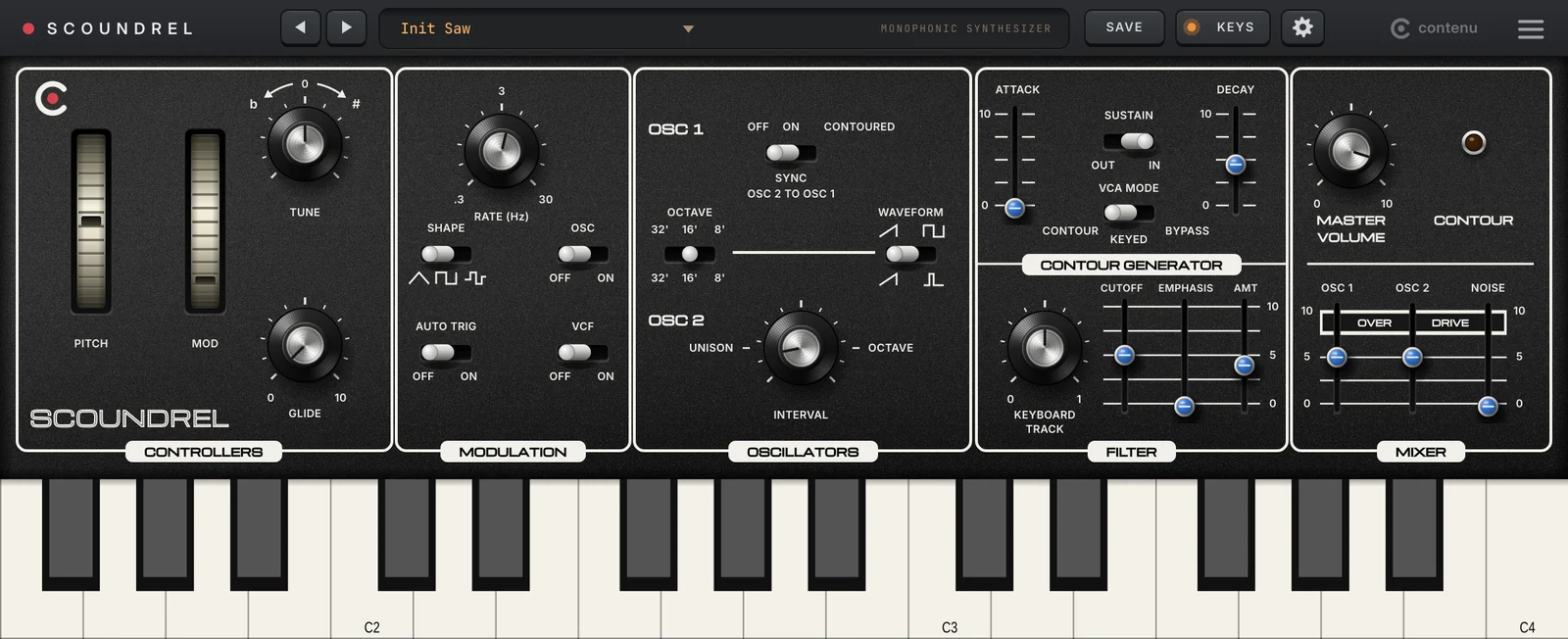
The panel is the instrument’s.
The original had no memory and a short list of controls. Every one of them is on Scoundrel’s panel, with the instrument’s ranges. Its quirks are kept too: lowest key wins, the contour only starts again when all keys are up, and a hot mixer overdrives the filter.
- Two oscillators with sync. Octave, waveform and an interval for oscillator 2.
- Ladder filter. Four-pole, with emphasis, contour amount and keyboard tracking.
- Modulation. A modulation oscillator with sample and hold, routed to pitch or filter.
- Plugin extras, out of the way. Presets, velocity, a wider bend and drift live in a Settings sheet.
In development · VST3, AU, Standalone
- Formats
- VST3, AU, Standalone
- Modelled from
- The factory service schematic
- Built with
- Claude Code, C++, JUCE 8
- Built
- Autumn 2026
- Version
- 0.2
- Availability
- Not yet released
How it was made
Part by part, from the drawing.
I don’t read C++. Claude Code wrote all of it, and did the research with me. My part was the direction: which sources to trust, what to measure, what to build next, and when a build sounded right.
Circuit notes
Every block traced to a part
Claude Code read the scanned service schematic stage by stage. Each block of the engine names the components it comes from: the shared exponential converter and saw cores of the oscillators, the pinking network behind the noise source, the glide’s resistor and capacitor. Where the manual and the schematic disagree, the notes say so and say which one the model follows.
Tests
Checked against the manual
The engine tests compare its behaviour with the figures in the service manual. A snapshot tool draws the editor without a host, so every screen in the owner’s manual is rendered from the real plugin.
An independent model of a vintage instrument. Not affiliated with or endorsed by the original manufacturer. Product names are trademarks of their owners.
Contact
Questions, ideas or a conversation?
I’m always glad to hear from people working on AI, product strategy, transformation or software.