Software · Origin
Origin, a programmable 1981 synthesizer, firmware and all.
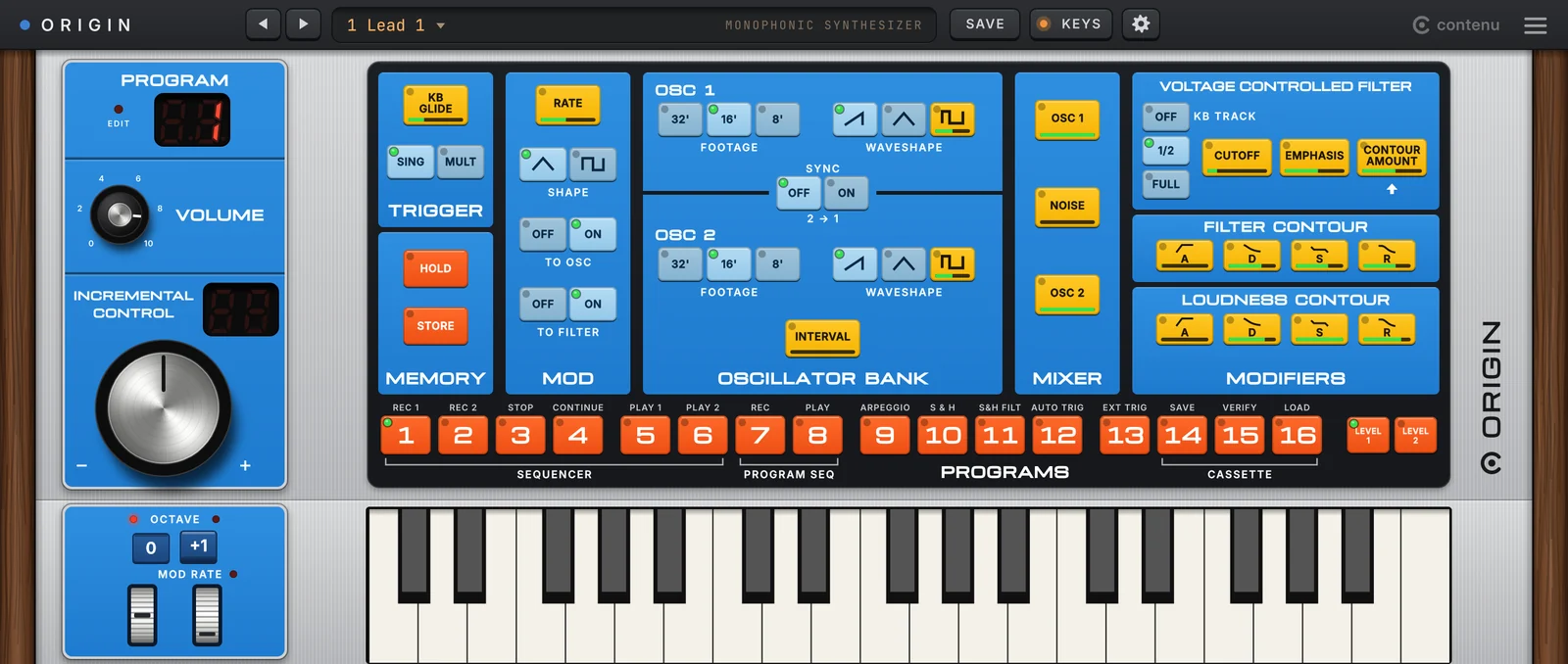
Origin is a monophonic synthesizer with a memory. Its sound engine was built from the service schematics of a programmable American classic from 1981; its memory, sequencers and arpeggiator follow the instrument’s own firmware, read from the original ROM.
It works like the instrument.
One big knob edits whatever pad you touched last, sixteen orange pads hold your programs, and a second level turns those pads into a sequencer, an arpeggiator and a program sequencer. Step sizes, sequence length and transposition behave as on the hardware.
- The complete voice. Two oscillators with sync, noise, the ladder filter, two contours, LFO and sample and hold.
- 48 programs. The 16 factory programs from the owner’s manual and a second bank of 32.
- Cassette, both ways. A recording of a real instrument’s SAVE loads into Origin, and Origin’s saved audio loads into a real instrument.
- In the host. Every control automates, and the sequencer follows host tempo.
Version 1.0 · VST3, AU, Standalone · Windows build tested
- Formats
- VST3, AU, Standalone
- Modelled from
- Service schematics and the 4 KB Z-80 ROM
- Built with
- Claude Code, C++, JUCE 8
- Built
- Autumn 2026
- Tested
- Five test suites, pluginval at strictness 10
- Availability
- Not yet released
How it was made
A disassembled ROM, and a schematic that disagrees with it.
I don’t read C++. Claude Code wrote all of it, and did the research with me. My part was the direction: which sources to trust, what to measure, what to build next, and when a build sounded right.
The firmware
Behaviour from the code itself
Claude Code disassembled the original 4 KB Z-80 ROM, and the digital side follows it: how the keyboard is scanned, how many steps each control has, how sequences and the arpeggiator run. It also showed that one voltage printed on the schematic belongs to a different ROM revision, so the model follows the code.
The cassette
A 1981 tape format, both ways
The instrument saved its programs to cassette. Origin writes and reads that audio signal in the original format, so a recording of the hardware’s SAVE loads into the plugin, and a file saved by the plugin is meant to load into the hardware.
Five test suites
Engine, controller, programs, tape, plugin
Each part has its own tests, and every factory program is rendered and compared with stored references after a change. The plugin passes pluginval at its strictest setting.
An independent model of a vintage instrument. Not affiliated with or endorsed by the original manufacturer. Product names are trademarks of their owners.
Contact
Questions, ideas or a conversation?
I’m always glad to hear from people working on AI, product strategy, transformation or software.